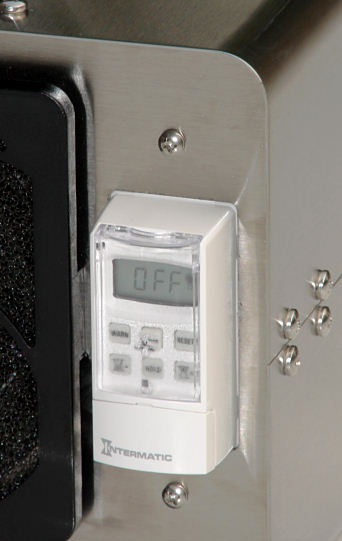
-
Many
competitor timers do not go past 2 hours, or go for even less time than
this!
-
For most shock
treatment needs, and for professionals in the business of fire restoration,
flood restoration, and mold redemption, these timers would not be used as
more time is usually needed for larger tasks or thorough bacteria, virus,
and mold killing.
Understanding Ozone Depletion
It is a myth that
ozone will only be active for a 30 minute period. Ozone has a
"half-life" of 30 minutes, which means, under normal conditions, that 50% of
an amount of ozone is usually converted back into oxygen in 30 minutes, and
again, 50% of the remaining amount of ozone is usually converted back into
oxygen for each subsequent 30 minute period - and so the amount of ozone is
being cut in half every 30 minutes.
Ozone is built up
in concentration in much the same manner in which it is depleted, however,
when performing shock treatments, the first couple 30 minute intervals or so
will actually build the ozone concentration slower than the subsequent
30 minute periods. This is because the ozone reacts or depletes much
more rapidly in the presence of contaminants, such as smoke, mold, bacteria,
chemicals, and other impurities. Larger concentrations of ozone can be
achieved over several hours to days if needed for heavily contaminated areas.
So if a competitor
claims that ozone will be gone in 30 minutes, or that it is useless to shock
treat for more than 30 minutes or an hour, it is now easy to understand this
claim is either made from a simple lack of knowledge, or to gain more sales
and help sell units with inadequate built-in timers.
NOTE:
Ozone is depleted much more rapidly in
high temperatures, than in low temperatures. At COLD temperatures, such as
freezing, ozone may not be depleted for over 30 Days. It is important to
use ozone in temperatures above 60 degrees Fahrenheit.
Do aggressive competitor statements
have you concerned about anything?
Read our
Informed Decision page for answers and resolution of many
issues. |
|